
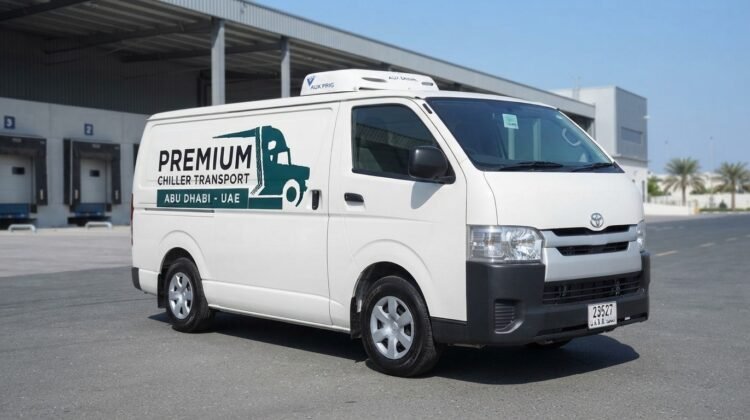
Cold Chain Logistics
What is cold chain logistics? A plain-English UAE guide
“Cold chain” gets used a lot and explained rarely. Here’s what it actually means, why one hot afternoon can undo the whole thing, and how it works day-to-day in the UAE.
Table of Contents
If you move food, flowers, or medicine in the UAE, you are already running a cold chain whether you call it that or not. The phrase sounds technical, but the idea is simple: keep a product inside its safe temperature band from the moment it’s made until the moment it’s used, without a single warm gap in between.
The catch is in those last four words. A chain is only as strong as its weakest link, and in a country where the summer air sits above 45°C, the weak link is usually a few unguarded minutes, a pallet left on a loading bay, or a van door propped open through a long stop. This guide walks through what the cold chain is, how the pieces fit together, and the places we most often see it slip.
What “cold chain” actually means
A cold chain is an unbroken run of temperature-controlled steps that keeps perishable goods within a defined range. For most fresh food that range is 0–8 °C; for frozen goods it’s around −18 °C; for many medicines it’s a tight 2–8 °C. “Logistics” is simply the coordination of the vehicles, storage, handling, and timing that keep the product inside that range end to end.
The reason it matters isn’t just spoilage you can see. Bacteria multiply fastest in the so-called danger zone above roughly 5 °C, and a product can become unsafe long before it looks or smells wrong. A vaccine that got too warm for an hour may still look identical in the vial and be worthless. The whole point of the cold chain is to protect against the damage you can’t see.
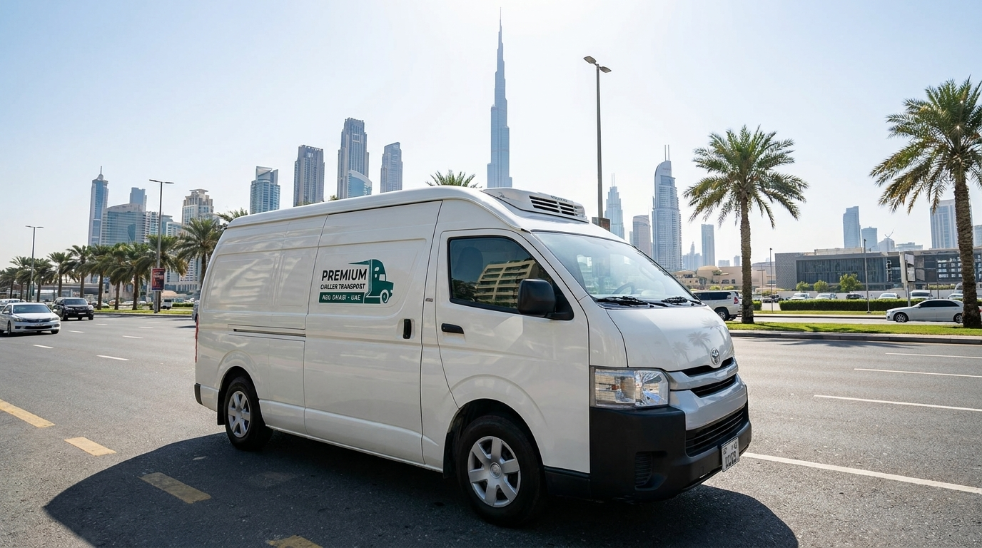
The links in the chain
Picture a punnet of strawberries or a tray of chilled medicine moving from source to customer. A typical chain has five links:
- Pre-cooling / production: the goods are brought down to temperature at the farm, factory, or cold store before anything moves.
- Cold storage: They wait in a chiller or freezer room, still inside the band.
- Loading: the highest-risk moment, because the product is briefly exposed to ambient heat as it crosses the bay.
- Transport: a refrigerated van or truck holds the temperature on the road.
- Last mile & handover: the final delivery, often multi-drop, where doors open again and again.
If you miss any one of them, the effort spent on the others is wasted. A perfectly refrigerated van cannot rescue a load that sat warm on the bay for twenty minutes before it went in.
Why the UAE makes it harder
Every cold chain fights physics; the UAE just turns the difficulty up. Three local realities shape how it works here:
The heat is relentless, not occasional
In much of Europe, a delivery van sitting in the sun is a summer problem. Here it’s the default for half the year. A refrigeration unit that works well at an ambient temperature of 25 °C often struggles to cool a warm cargo van rental hold back down to 45 °C, which is why pre-cooling the vehicle before loading is essential.
Second, distances and inter-emirate runs matter. A load can leave Al Aweer market in Dubai before dawn and be crossing to Abu Dhabi or over the Hajar Mountains to Fujairah by mid-morning; the cold has to hold for the whole crossing, not just the first ten kilometers. Third, the rules are real and enforced: Dubai Municipality and other authorities set clear requirements for how food is transported, and audits happen. The cold chain here is a compliance issue as much as a quality one.
Where the chain usually breaks
After years of doing nothing but cold transport, the failures we see cluster in the same few spots, and most of them are caused by something other than the fridge unit failing on the road:
- Loading a warm van. The unit cools air, not a hot metal box full of warm boxes. Load a van that hasn’t been pre-cooled, and it spends the first part of the journey catching up, sometimes never fully catching up once the doors start to open.
- Door discipline on multi-drop routes. Ten drops means ten door openings. Each one lets a wash of hot air in. Cold falls out of an open door fast in the sun; disciplined, quick openings are half the battle.
- The gap before and after transport. Goods sitting on an unshaded bay waiting to be collected, or left in a warm back room after delivery, sit outside of anyone’s refrigeration.
- Mixing loads that don’t belong together. Putting frozen and chilled goods in one zone forces a compromise temperature that’s wrong for both unless you use a multi-temperature vehicle with separate zones.
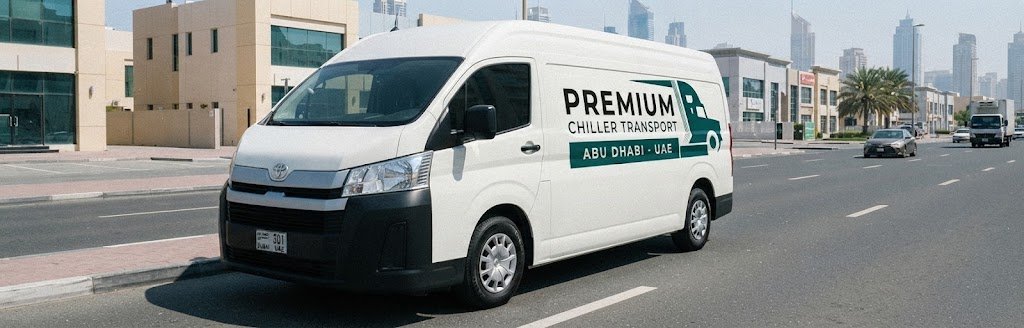
Vans, trucks, and storage: Who does what
The transport link is divided by size and temperature. Vans handle city and last-mile work; trucks handle pallets and bulk. Chiller equipment holds fresh things; freezer equipment holds frozen things. Roughly:
| Need | Temperature | Usual vehicle |
|---|---|---|
| Fresh produce, dairy, flowers, most medicine | 0–8 °C | Chiller van or chiller truck |
| Ice cream, frozen meat, frozen ready meals | −18°C | Freezer van or freezer truck |
| Both on one route | Two zones | Multi-temperature van/truck |
| Bulk / pallet / inter-emirate | Either band | Refrigerated truck |
Not sure whether you need a chiller or a freezer? We wrote a separate guide on exactly that; see chiller van vs freezer van.
Getting it right
You don’t need to become a refrigeration engineer to run a solid cold chain. You need pre-cooled vehicles, quick and disciplined handling at every open door, temperature monitoring where a client or auditor wants proof, and a transport partner who treats the load the way you would. For pharma and medical goods, the bar is even higher; that’s the world of GDP-aligned transport, where the temperature record itself is part of the product.
Handled well, the cold chain is invisible: the customer simply gets fresh strawberries, unmelted ice cream, or medicine that works. That invisibility is the whole job.
The short version
- Cold chain = keeping goods in their safe band, with no warm gaps, from source to use.
- The chain breaks at handling moments loading and open doors far more often than on the road.
- The UAE’s heat, distances and food-transport rules make pre-cooling and monitoring non-negotiable.
- Match the vehicle to temperature (chiller vs freezer) and size (van vs truck).
Where to next
Related services & guides
The services and guides that put this into practice.
- Cold chain logistics: End-to-end cold transport across the UAE
- Refrigerated van rental: Chiller & freezer vans
- Pharma cold transport: GDP-aligned medical loads
- Chiller vs freezer van: Which vehicle you need
- Temp-controlled guide: The complete overview
- Chiller van rental: 0–8°C fresh loads
Need the transport link handled?
We run the on-road part of your cold chain with pre-cooled vans and trucks, monitored where you need proof, across all seven emirates.
FAQ About Cold Chain Logistics: Quick Answers
Q: What is the cold chain in simple terms?
It’s the unbroken sequence of temperature-controlled steps pre-cooling, storage, loading, transport, and delivery that keeps perishable goods inside their safe temperature band from source to customer, with no warm gaps. What temperature is a cold chain kept at?
Q: What temperature is a cold chain kept at?
It depends on the product: roughly 0–8 °C for fresh food and flowers, around −18 °C for frozen goods, and a tight 2–8 °C for many medicines and vaccines.
Q: Why is cold chain harder in the UAE?
Summer ambient temperatures above 45°C, long inter-emirate distances, and enforced food-transport rules mean vehicles must be pre-cooled and handling must be fast and disciplined to keep the chain intact.
Q: Where does the cold chain most often break?
Almost always at handling moments loading a van that wasn’t pre-cooled, or leaving doors open too long on multi-drop routes — rather than the refrigeration unit failing on the road.
Vehicles
Contact
+971503195236
Mussafah, Abu Dhabi, UAE